



FIELD BRIEF #001 / PUBLIC RECORD
Subject: 191 Homes in 2026 - and the one that breaks the assumption
Prepared by: Daniel Edwards
Delivered to: Investors · Stewards · Civic Readers · Neighbors
Timestamp: 2026-01-05 | numbered into the record 2026-08-06
Why This Matters (Read This First)
Radical Reframe (Read This Slowly)
What if Kansas City doesn’t actually have an affordability crisis — but an Impossible Housing crisis?
What if a few “crazy” people decided to reject business as usual and take one simple next step: build an entirely new housing industry from the ground up?
And what if a ground up new industry began with a collective commitment to produce 191 + 1 homes in 2026?
The Impossible Housing Crisis is the unspoken belief held by the existing housing industry that the the places and people who need housing the most are not worth the effort required to change the industry’s business model — because it has already decided that urban core production is impossible.
Everyone defaults to this belief.
Many have attempted to change this belief, even internally within the system.
But every project to date is subject to this belief.
And solving any housing crisis is impossible build on this framework.
If Kansas City built a real housing industry — not a collection of pilots — the impact would be massive:
Thousands of permanent jobs across construction, manufacturing, design, logistics, finance, and neighborhood services
Based on the data: between $4.4 billion and $21.8 billion in local economic impact from housing production alone, through wages, supply chains, and reinvestment
Lower housing costs through scale, not subsidies alone
Grocery stores that can remain open and amenities that can be sustained through sufficient density and disposable income
Stability for families, compounding into better health, stronger educational outcomes, and greater workforce participation
This isn’t just a housing problem. It’s an economic production opportunity hiding in plain sight — and it starts with a simple, concrete challenge:
What if everyday people joined together and built
191 homes + 1 in 2026?
Not as a one‑off project. Not as a pilot. But as proof that an entirely new housing industry — designed to build where need is highest — can replace the one that exists doesn’t care about the crisis today.
191 + 1 Homes: Why This Number Matters
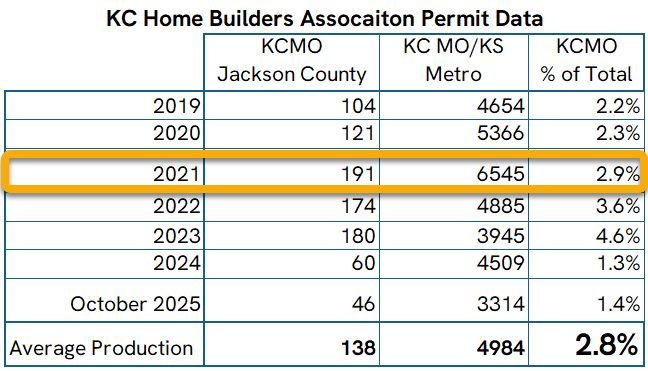
For the last several years, 191 homes has quietly functioned as a ceiling.
Using builder permit data only, production in the urban core has declined since 2019, averaging just 138 single‑family homes per year. Not because demand disappeared — but because the existing housing industry never expected, planned, or designed itself to exceed that level of output.
That’s why 191 + 1 matters.
The goal is not to replace what the city is already capable of producing — limited and inconsistent as that production may be.
The goal is to add 191 + 1 net‑new homes in 2026, built by people and partnerships ready to invest in a new industry that can overpower those that have already decided urban core production isn’t worth the effort.
So 191 + 1 isn’t about volume.
It’s about proving that an entirely new housing industry can exist — one that builds where need is highest, measures success by throughput, and is willing to cross the line the current system refuses to.
That “+1” is the moment a belief breaks.
And once that belief breaks, a new housing industry can begin.
2026 New Year’s Resolution
Stop talking to people who don’t trust you — and start talking to people who do.
This section of news.onemillion.homes is dedicated to everyday People who are ready to build something different:
Practioners: Builders. Trades. Investors. Employers. Civic leaders. Housing Support organizations.
People: Teachers, first responders, artists, folks who work downtown, folks who families grew up in the city and have always talked about coming home if____ was in place.
Outside Folks: People who have similar issues in their communities and are looking for a solution to overpower the normal of their own cities.
People who understand that if we want different results, we can’t keep operating inside an industry designed to avoid scale.
How We Got to “Impossible Housing”
We didn’t arrive at this conclusion casually.
We did the practical thing. We checked the boxes. We worked with the gatekeepers. Banks, CDFIs, Philanthropy, Politian’s, City Staff, yada yada yada. We sat in the rooms we were told mattered. We partnered, applied, revised, waited, and repeated.
Over time, a pattern became impossible to ignore.
New Initiatives were announced. New sources of funding. New promises were made. Planning, committees, surveys. Communities were told change was coming. Then time kicked in, delays increased, priorities shifted. Leadership turned over. Burnout set in. People began to loose trust.
What didn’t change was housing production in the urban core.
After years of good‑faith participation, we were forced to confront a baseline truth:
The system isn’t failing because people don’t care.
It’s failing because it is operating from a belief that real, sustained housing production in the urban core is not actually possible.
That belief quietly shapes deal sizes, timelines, risk tolerance, and ambition — until outcomes fit what the industry already believes is achievable.
We call this Impossible Housing.
The Receipts: What Kansas City Is Actually Producing
Before we go any further, we want to ground this conversation in facts — not opinions.
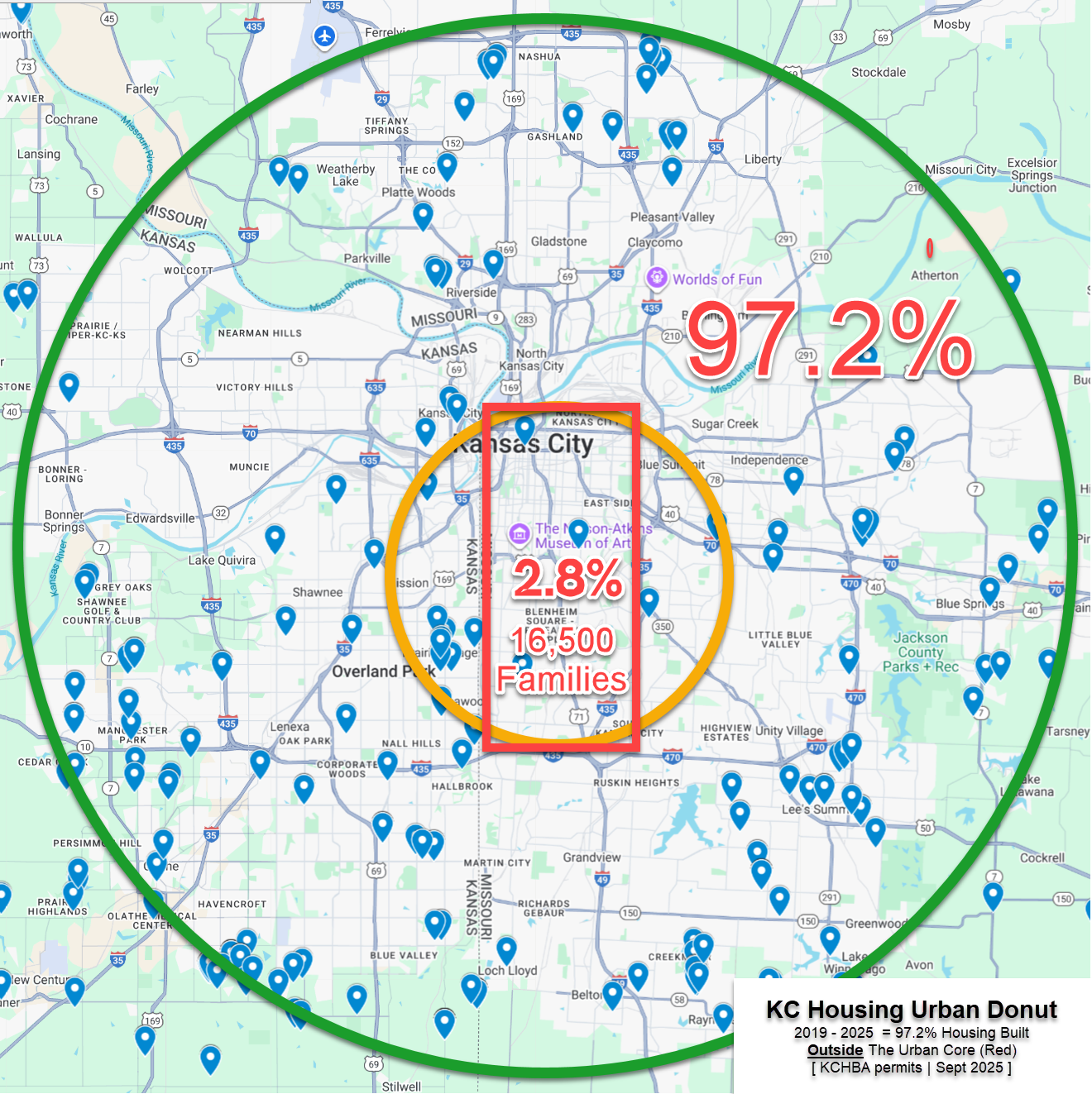
Using KC Home Builders Association permit data, we’re looking specifically at the urban core of Kansas City — River to 435, State Line to 435 — the area where housing need is most concentrated and production matters most.
Here’s what the data shows:
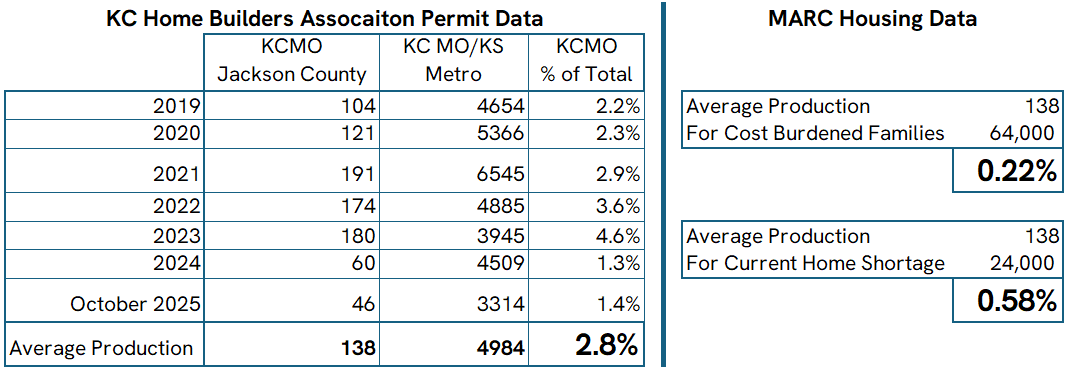
Since 2019, the urban core has never produced more than 191 new single‑family homes in a year.
In 2024, that number dropped to 60 homes.
By October 2025, it stands at 46 homes.
Across those years, the urban core has averaged just 138 new homes per year.
For context, the broader KC metro averages nearly 5,000 single‑family permits per year. That means 97.2% of all new construction happens outside the urban core — even though we know that at least 16,500 families in the urban core earn enough income to afford a new‑construction home if someone actually built one.
![The [Urban Core] Housing Donut Dilemma](https://substackcdn.com/image/fetch/$s_!Wz24!,w_140,h_140,c_fill,f_webp,q_auto:good,fl_progressive:steep,g_auto/https%3A%2F%2Fsubstack-post-media.s3.amazonaws.com%2Fpublic%2Fimages%2F8d43e25c-4273-437e-ab0c-00bf5041c352_1320x1323.png)
Now here’s the challenge.
If MARC tells us Kansas City needs 12,000–24,000 new homes, why are we not designing solution for 24,000 + 1 homes? Why are we comfortable aiming below the low end of that range?
If the data shows 64,000 cost‑burdened families, why aren’t we designing solutions for 64,000 + 1 families?
Why do we continue to depend on a housing industry that is comfortable producing only 138 homes a year in the very place where need is greatest?
191 + 1 is our answer to that contradiction.
Not because it solves the entire shortage — but because it represents the first deliberate act of building beyond what the existing industry believes is possible.
It’s not a forecast.
It’s a line in the sand.
And crossing it is enough to jumpstart an entirely new housing industry.
Recommended Next Move
If this resonates, don’t just read — locate yourself.
Ask:
Where do I influence housing decisions, narratives, or capital?
What assumptions do I quietly accept as “just the way it is”?
Who else needs to see this data — not as a critique, but as a wake-up call?
The next issue will unpack why this pattern persists — even with good people and real money — and what has to change for Kansas City to move from pilots to production.
Share + Shape What Comes Next
If this reframed something for you, don’t keep it to yourself.
Share this post with someone who influences housing decisions, capital, policy, or narrative.
Comment below or inbox us directly and tell us:
What questions about housing, production, or scale do you want answered in 2026?
If you could participate in a true win‑win future — where cities build, families thrive, and opportunity compounds — what would that look like for you?
This newsletter isn’t a monologue. It’s an invitation to co‑design a future that actually gets built.