



FIELD BRIEF #006 / PUBLIC RECORD
Subject: The dividing line no one talks about
Prepared by: Daniel Edwards
Delivered to: Investors · Stewards · Civic Readers · Neighbors
Timestamp: 2026-08-05
As I write this, my team is in underwriting with a lender on a new-home ownership project on the east side of Kansas City — 500 homes.
The lender’s concern, nearly word for word: “Dan, we’re worried this project is underwater before the first unit is built. It costs more to build these homes than you can sell them for, based on the comps.”
“Beacon Hill is six blocks away,” I told them. “Homes there run four hundred to eight hundred thousand.”
They could see it. They still couldn’t make it work. I walked them through redlining, the production drought, everything I had.
Then, after a few days of digging, I sat back in my seat and said out loud, to an empty room:
what the f*#&.
If I shift the project’s address of record one block —
not the project,
not the construction type,
not the unit count,
just the address —
the whole project works.
For New Construction:
Here is what one block does. A new home here costs about $300,000 to build, on either side of the line — same lumber, same codes, same crews.
Put the address of record on one side and that home appraises around $350,000. The loan works.
Put it on the other side and the same home appraises around $260,000. Underwater before the first shovel.
A $90,000 appraisal swing, thrown by the address of record.
For Existing Homes:
Why? Because of what the appraiser is allowed to compare the home to. Existing homes on one side of that line sell around $580,000. On the other side — 6X less. Same street. Stand in the middle of it and your left foot is worth 6X more than your right.
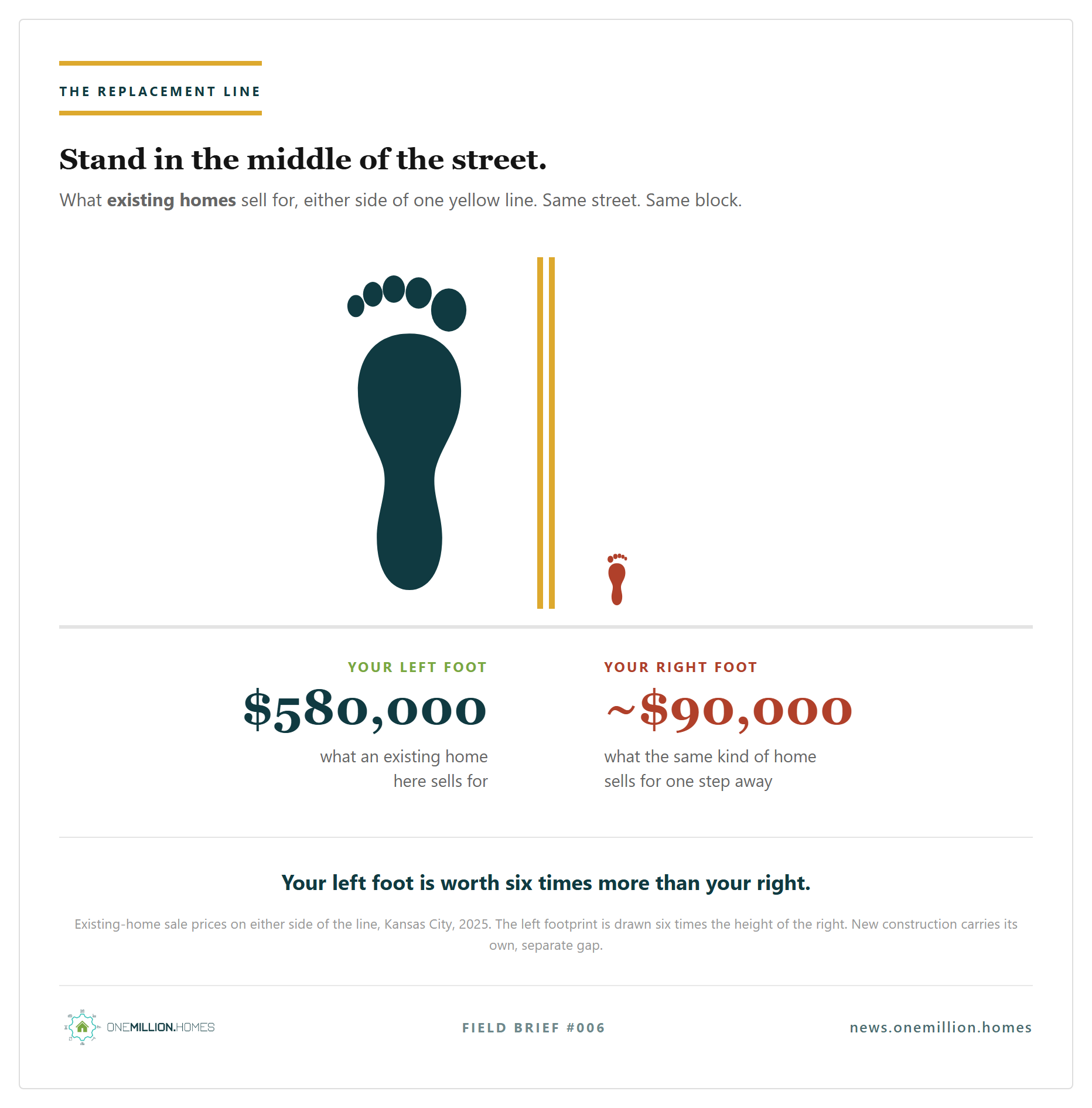
But it’s not just one block. It’s one invisible system that carves up our city and cities across America.
People talk about coming up on the wrong side of the tracks. Back then it was the wrong side of the railroad tracks.
Today, it’s been made permanent as the wrong side of the Census Tracts.
It’s as simple as the wrong side of the yellow stripe painted down the middle of an ordinary street.
1) The families who are already ready
Start with a number nobody uses. There are more than 21,000 families in Kansas City earning enough, today, to buy a home priced between $250,000 and $500,000.
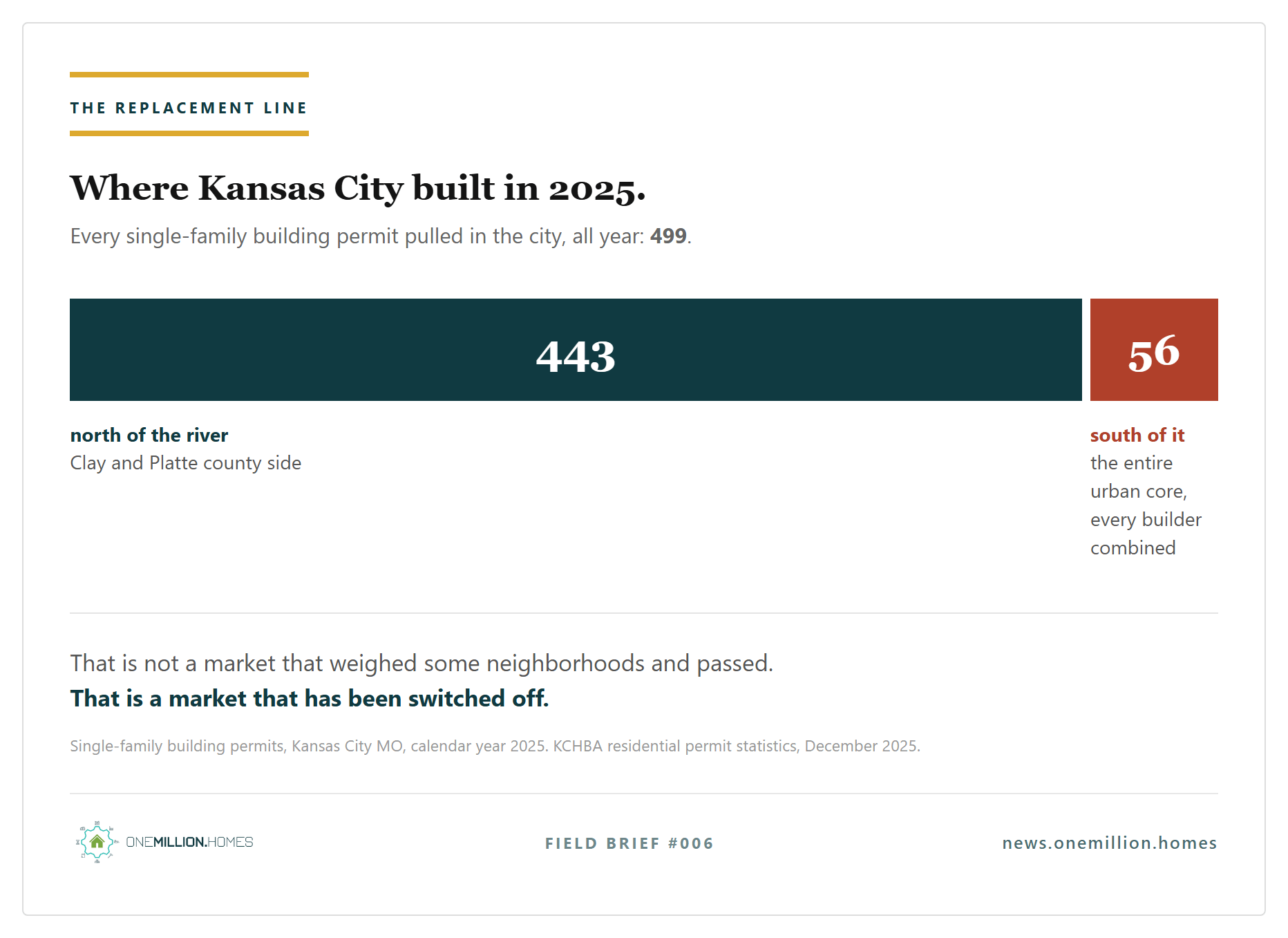
And against that demand, the Jackson County side of Kansas City — the side that holds the urban core — pulled 56 single-family building permits in all of 2025.
Studies say the Kansas City region is underbuilt by 12,000 to 24,000 homes, and we managed to pull out fifty-six.
Not us as a builder.
Every builder in the urban core of Kansas City, combined. Fifty-six.
The 21,000 families are not someday-buyers. Not with-a-subsidy buyers. Families whose paychecks already carry that mortgage — who rent anyway, because the homes they can afford don’t exist where their lives are.
Build homes in that range in the urban core and those families don’t join a waitlist. They become homeowners.
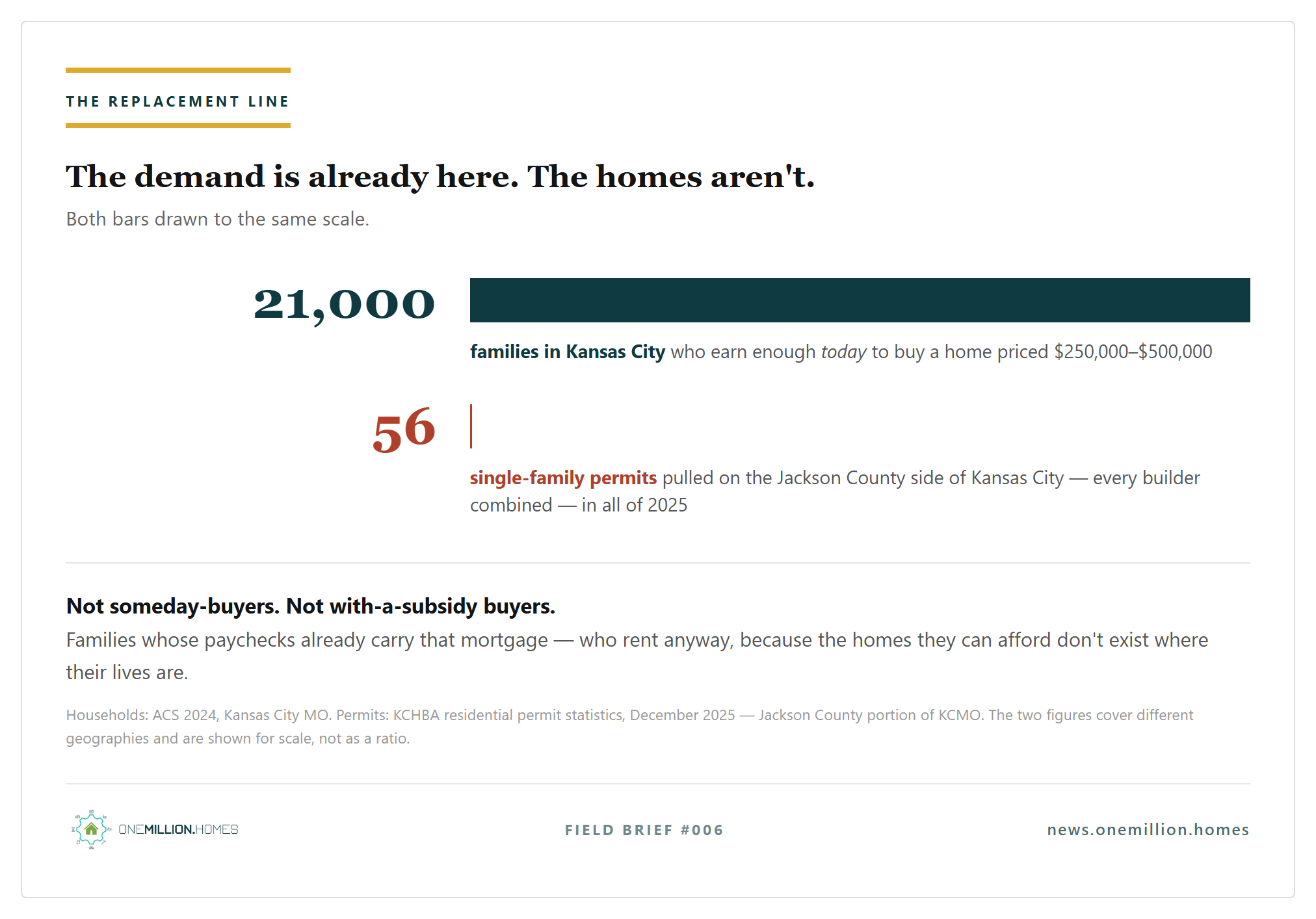
That’s the demand side of Kansas City’s housing story, and it is fully loaded. And on the current path, it will never happen — because almost nobody recognizes what’s stopping it, and the ones who do only learned it one way: in the trenches, trying to build.
What’s stopping it is that line. You can walk to it.
2) The corner
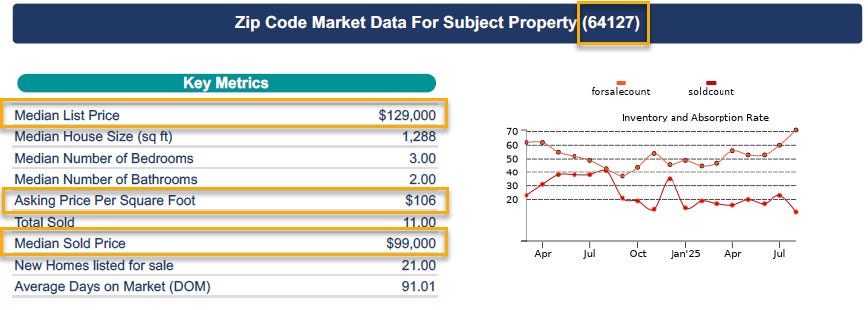
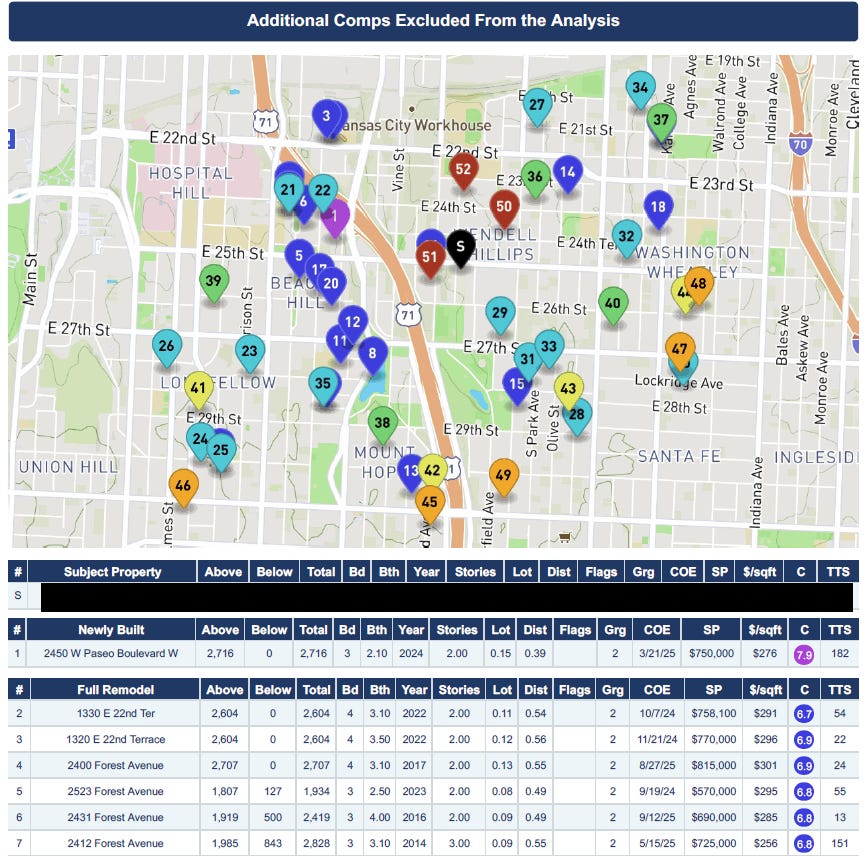
The corner is 25th and Woodland, on the east side of Kansas City. On one side of the street the ZIP code is 64127. Step across — same block, same soil, the same house you would build — and it’s 64108.
That street is a ZIP-code line — and, in the data that decides things, a census-tract line.
Hold onto that term: Census Tract.
The invisible parcels the government draws to count us are the parcels the housing machine reads to price us.
The Replacement Line doesn’t wander; it runs along their borders.
The folklore was off by one letter. Not the wrong side of the tracks — the wrong side of the tract.
To you and me, nothing changed. To the pipeline that decides whether a new home on that block ever gets built, the two sides are different worlds. One side, the numbers say build. The other side, the numbers say no. Same house. Across the street.
You already know a version of this line — Kansas City calls its version Troost. But the visible lines are a decoy. Stare at the highways and the old redline boundaries long enough and you end up holding the only story anyone ever tells about these blocks: history, grievance, and nothing you can do about it. The line that actually decides what gets built doesn’t run along a highway. It runs wherever one number crosses another.
3) The real line
Every home has two numbers.
#1 — What it would cost to build today. The replacement cost.
And
#2 — What it would sell for. The price.
The line is where they cross.
On one side:
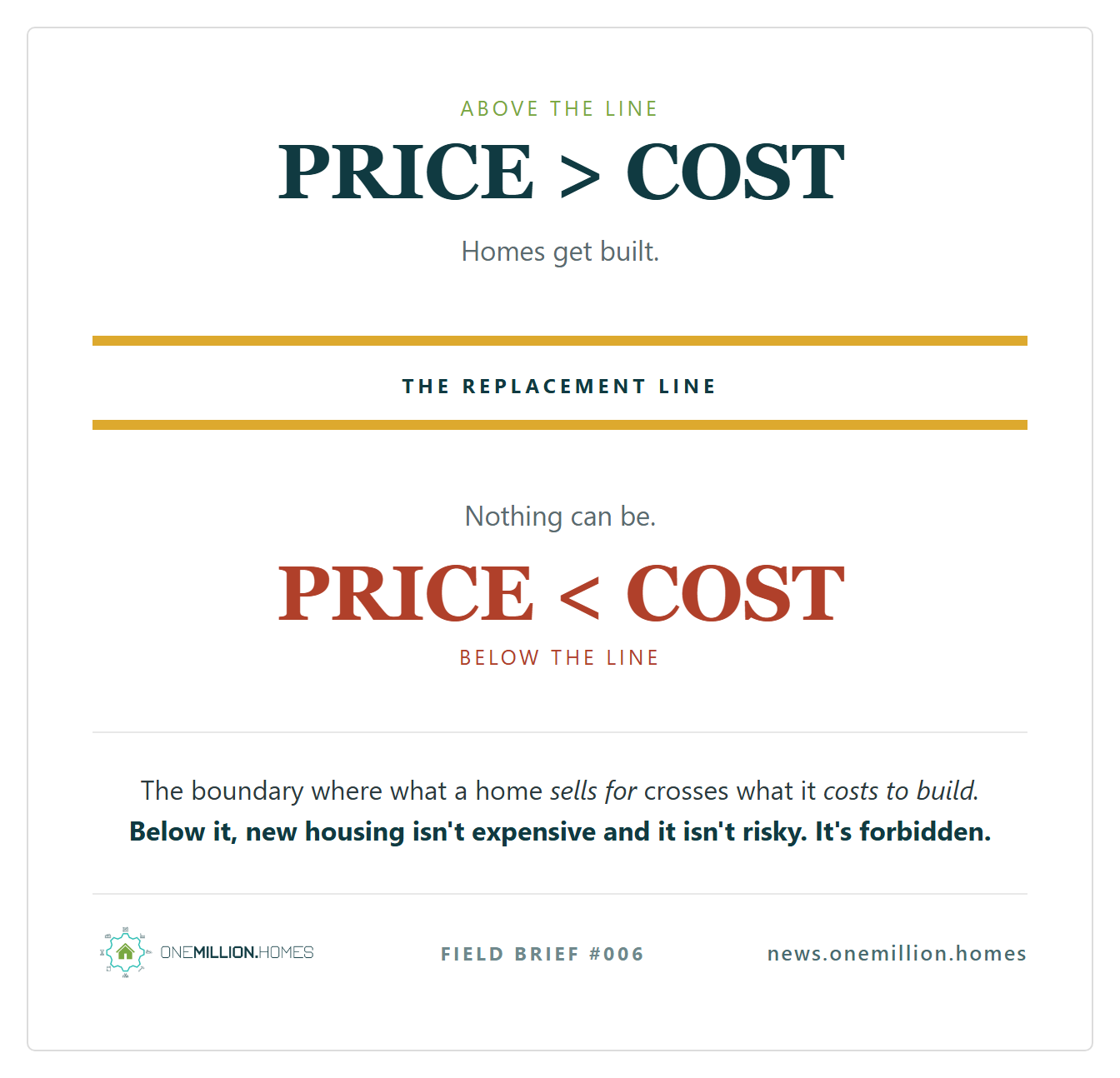
Price > Cost
A few streets over:
Price < Cost
Where price sits above the cost to build, homes get built — a builder can borrow, build, sell, and the math closes. That side is permitted.
Where price sits below the cost to build, no rational dollar can build a thing — not because nobody wants to live there, but because the finished house is worth less than the money it took to make it. That side is denied.
Below that line, new housing isn’t expensive, and it isn’t risky. It’s forbidden. The bankers have a word for a house they can’t lend against — uncollateralizable. I use a plainer one: Impossible Housing.
Call the boundary itself the Replacement Line. It is not a metaphor and it is not history. It’s a switch, not a verdict — and an algorithm holds the switch down. The same arithmetic cuts every city in the country into two halves along one invisible line.
4) What each side looks like when you stop doing math and start driving
Above the line: new homes going up, each closing becoming the comparable that makes the next one easier,
equity compounding for whoever already owns.
Below it: no new foundation poured in decades. Vacant lots that stay vacant even when the land is free — because free land plus a house that appraises under cost still loses money. Rehabs that stop at the cosmetic, because a renovation dollar comes back as fifty cents. A loop that seals itself: no new builds, no new comps, price stays under cost, no new builds. Eighty-seven years of ratchet.
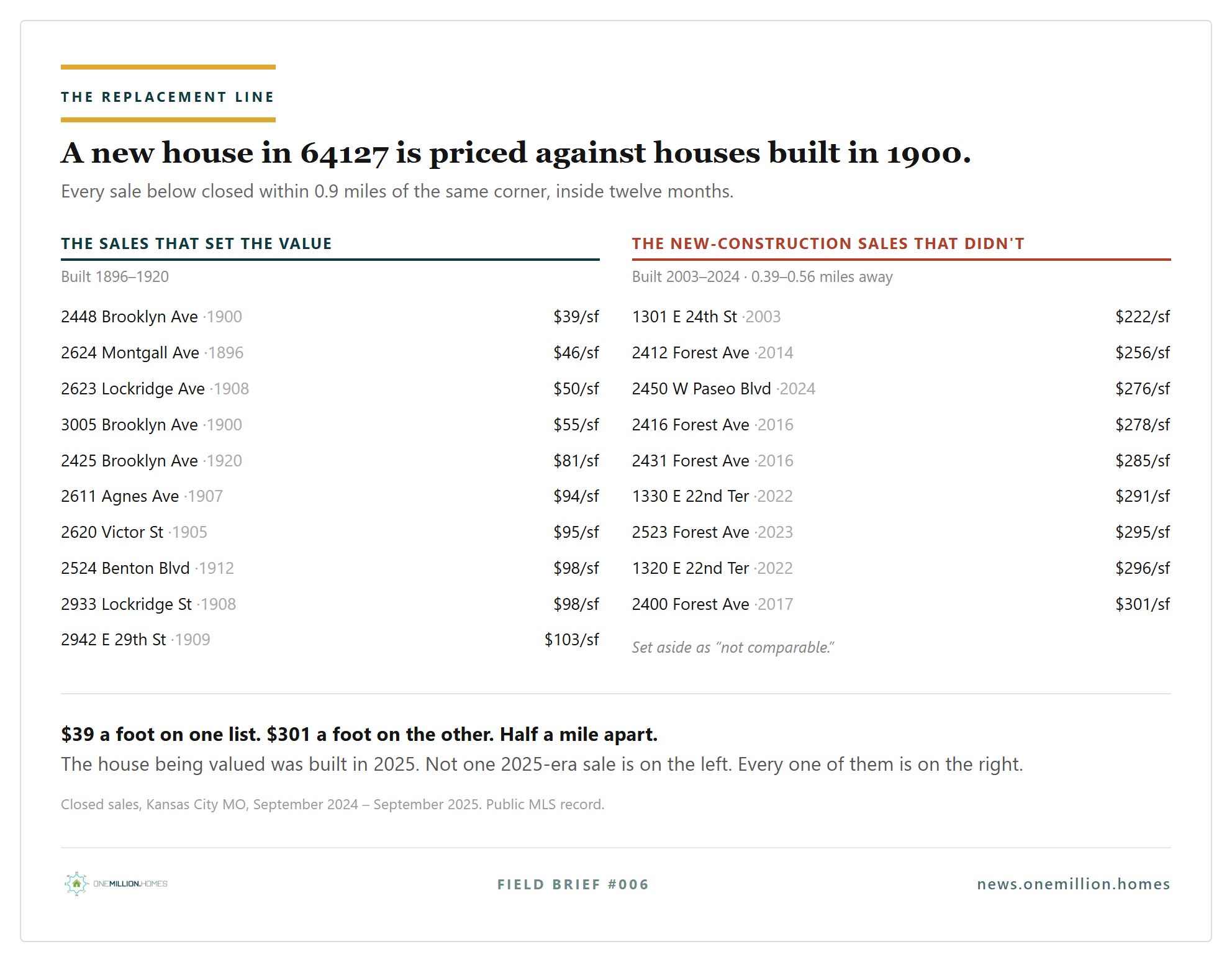
The whole city feels it: 499 single-family permits in all of 2025, and 443 of them landed north of the river. What’s left is the fifty-six — a full year’s building for the entire side of the city where the shortage lives. That is not a market that weighed some neighborhoods and passed. That is a market that has been switched off.
5) Who holds the switch
Nobody at a desk says no. A bank doesn’t ask what a home is worth; it asks what an appraiser can prove — and it sells the loan on to Fannie Mae or Freddie Mac, where an algorithm validates the appraisal by reading the neighborhood through the census tracts you met at the corner. Lay those tracts over the map the federal government drew in 1939 to mark which blocks were “hazardous,” and the lines still match. The “no” comes from the end of the chain, where an 87-year-old map still does its job — quietly, automatically, with a spreadsheet’s clean conscience.
I grew up inside one of those boundaries.
The market never judged these blocks. An algorithm did.
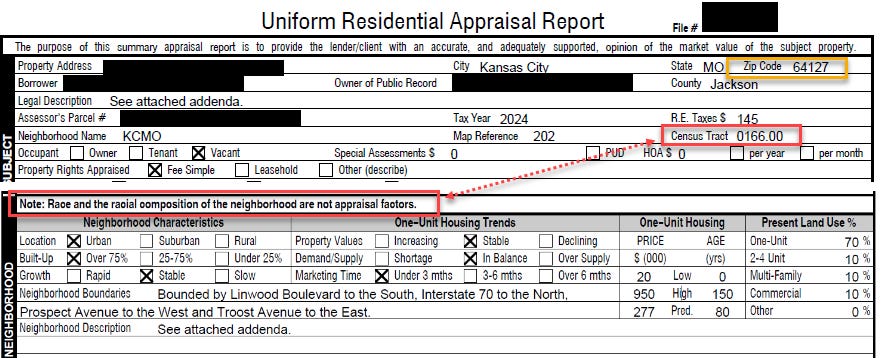
(How a 1939 map got laundered into a modern underwriting engine — the block groups, the patents, the one word that survived intact — is the next brief.)
6) The silence
We have sat in a lot of housing meetings. Task forces. Coalitions. Support groups. Planning sessions with real budgets and thick decks, run by committed people.
Not once have we heard this line named.
That is the part that should stop you. The single mechanism that decides whether a home can exist on these blocks — the root, not a symptom — goes unspoken in the exact rooms assembled to solve the crisis it causes. And what never gets spoken never gets changed.
So run a test. Listen to the people in charge of solving this. Read their plans. If the line isn’t in there — if the switch that turns housing off appears nowhere in the strategy — let that validate what it validates: we keep putting people in charge of a crisis whose plans aren’t built to cure it. They’re built to manage it. And a band-aid, renewed annually, is how an authority stays an authority.
The ones actually trying will pass this test without breaking stride. From here on you’ll know them when you hear them — they’ll say the quiet part. They’ll name the line.
7) The noise
Someone will say it’s just risk. Just the market. The comps are the comps.
But “risk” is the word a system uses to make a choice look like a law of nature. A market where the price of a home sits below the cost of its own existence isn’t pricing risk — it’s naming an injury. Below the Replacement Line, the invisible hand doesn’t allocate. It forbids.
And the counsel that rides along with the “no” is always the same: wait your turn. Phase one of twelve. Let’s run a pilot. In a place that has already waited three generations, patience stops being prudence and becomes a sedative.
8) The toll
Turn the $90,000 into a person.
In this system, a home’s price is roughly a household’s income times a fixed number — so a $90,000 gap in what a house can appraise for works out to about $27,000 of household income a year. That is the toll for standing on the wrong side of Woodland.
Which leaves one question, and I have never heard anyone answer it: what did the family on the east side of that street do to owe $27,000 a year that the family one block west does not?
Nobody can tell you. That’s the tell. A line no one can justify is a line someone drew — and a line someone drew is a line we can build across.
Now that you’ve seen it, you won’t stop seeing it. Drive your own city this week and find the intersection where the numbers flip. Every city has one.
You can argue with a line, or you can build across it. We’ve chosen — and not with a pilot. With a comp: the same engine that compounds the permitted side, pointed the other way. Every closing becomes the comparable that re-prices the next one. New comps move the line. How we’re doing it, from which side in, is its own brief. I’ll publish the receipts as we move: the maps, the math, the first closings on the wrong side of the street.
One more thing, said plainly: we’ve stopped writing for everybody. These briefs are for the people ready to see things happen differently — the ones who would rather hold the mechanism than the story about it. Not everyone wants that. That’s by design.
No hype. Just risk, named out loud.
[[ C40 — urban infill development · ULI — Infill Housing · NCRC — Redlining Score · Brookings — formerly redlined neighborhoods · Chicago Fed — redlining 1930 to today · Freddie Mac — appraisal valuation gap ]]
Operators Code terms in this brief:
The Replacement Line · Impossible Housing
Run The Test. Report Back.
The street in your city where the numbers flip. Every city has one. Name it.
What your city’s housing plan says when you search it for the word “appraisal.”
If a project of yours ever died on the appraisal — what the gap was, and where the lot sat.
An answer to the question: what did the family on the east side do to owe $27,000 a year?
If you work in appraisal or underwriting and I’ve got the mechanism wrong — say so here.


