



TL;DR: Some organizations help move resources toward the people doing the work. Others learn the work, rename it, and move the practitioner out of the way. This Brief names the Explanation Industry, explains how extraction becomes exclusion, and gives stewards a practical set of questions to tell the difference between a non-extractive bridge and a wolf in sheep’s clothing.
FIELD BRIEF #001 / PUBLIC RECORD
Prepared by: Daniel Edwards
Delivered to: Stewards with Resources · Operators · Civic Readers
Subject: The Explanation Industry
Timestamp: 2026-05-13
Some organizations help move resources toward the work.
Others learn the work, rename it, and move the practitioner out of the way.
Stewards need to know the difference.
1) The question(s) in the room
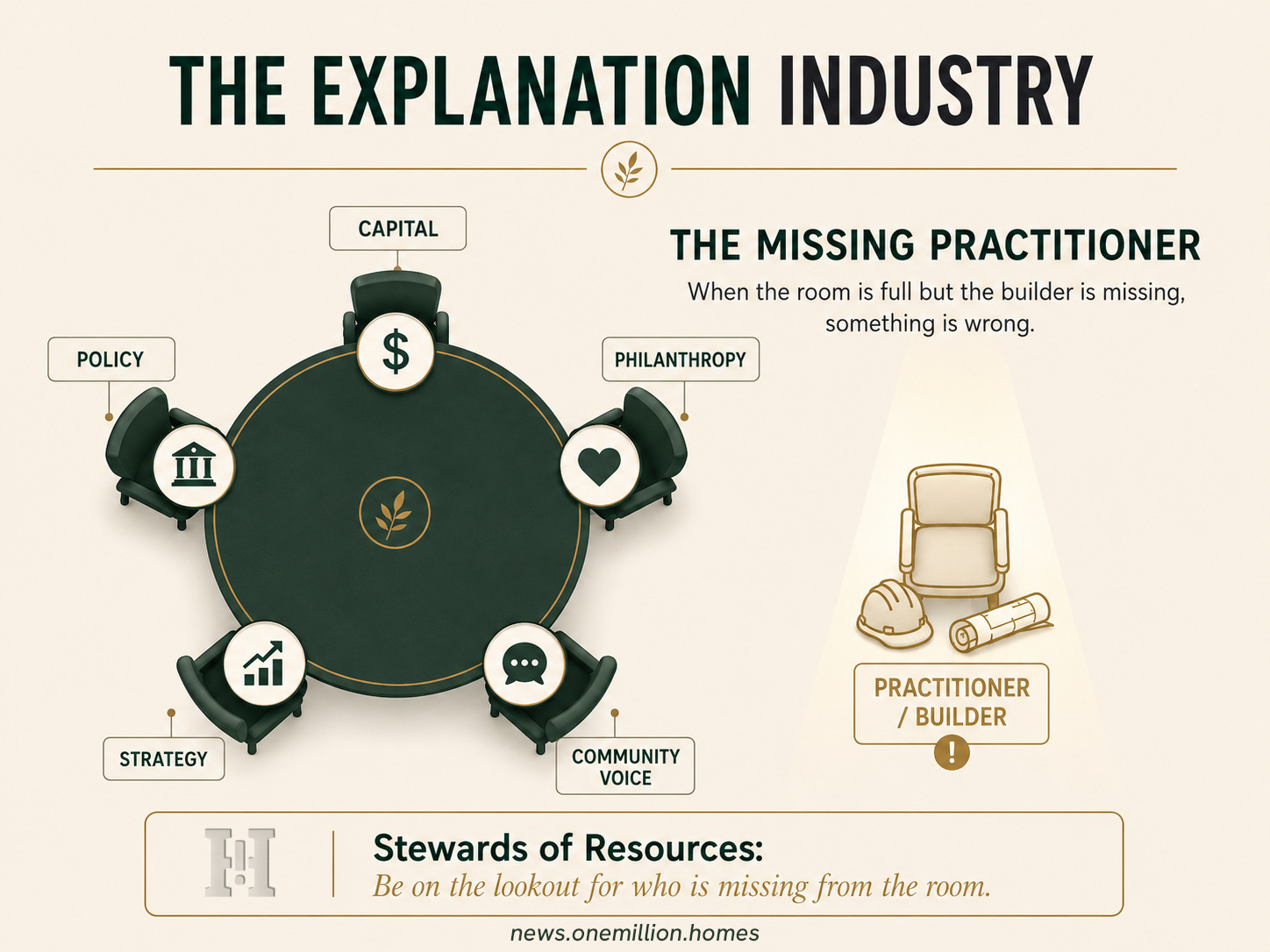
At a recent regional housing meeting, someone quietly asked the question that has been sitting underneath Kansas City’s housing conversation for years:
Why aren’t there more urban-core developers in these rooms?
It was the right question.
But it was not the whole question.
The fuller question is this:
Why do the rooms keep filling with people funded to explain the problem, while the people building inside the problem are treated like risks?
Urban-core homeownership production has not failed to scale because nobody cares. It has not failed because the problem has never been studied. It has not failed because there are no practitioners with real answers.
It has failed, in part, because a funded layer has learned how to sit between the problem and the people solving it.
That layer has a name.
The Explanation Industry.
2) The Explanation Industry
The Explanation Industry is the funded layer that sits between hard problems and operational answers.
It produces studies, panels, frameworks, working groups, listening sessions, strategic plans, dashboards, and public language around the problem.
Some of this work is sincere.
Some of it is useful.
Some of it helps real people.
But when explanation becomes more fundable than production,
the system starts optimizing for the persistence of the problem.
That is the issue.
Not always intent.
Output.
A model can help people at the edges and still fail to reach critical mass. A program can be good and still not be built to solve the category.
A convening can be well-intended and still become the place where practitioner knowledge gets converted into someone else’s fundable strategy.
And if the people explaining the problem become more fundable than the people solving it, the problem does not get solved.
It gets managed.
It gets studied.
It gets overcomplicated.
It gets reframed.
It gets convened.
It gets renewed.
But it never get solved.
3) The Bridge and the Wolf
Not every intermediary is extractive.
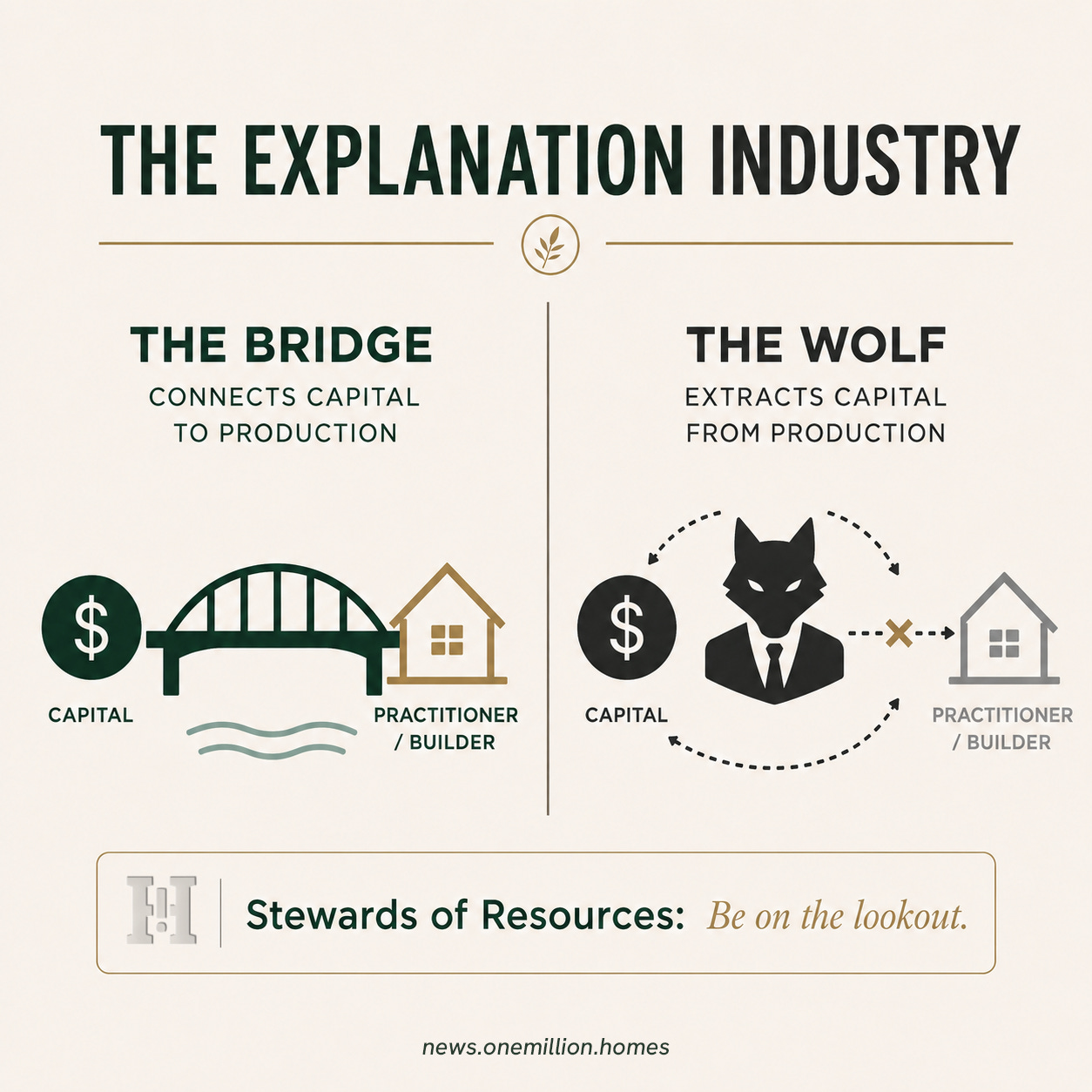
The Impact of a Solid Bridge:
A non-extractive bridge helps resources reach the practitioner without taking ownership of the practitioner’s work.
It protects provenance.
It clarifies who originated the strategy.
It makes the room safer for the person closest to the problem. It absorbs complexity without converting itself into the center of the story.
A bridge knows its job is connection.
The Impact of a Wolf:
A wolf learns the practitioner’s language and challenges.
Repeats it under a more fundable logo.
Quietly explains why the practitioner should not be funded.
Leverages their social capital for why they are the safe-haven for new change.
A wolf knows its job is capture.
From the outside, the bridge and the wolf can look similar.
Both speak the language of collaboration. Both talk about trust. Both know how to sit with funders. Both can produce a clean deck. Both can tell the story of the community. Both may even produce some visible good.
That is what makes discernment necessary.
The question for stewards is not:
Do they sound aligned?
Everyone sounds aligned in the room.
The question is:
Does their model move power, capital, credit, and decision-making closer to the practitioner — or farther away?
That is the test.
4) The Extraction Loop
The pattern is not complicated.
A hard problem exists.
Practitioners develop an operational answer.
The Explanation Industry invites the practitioner into meetings under the language of support:
The practitioner shares the work.
Language. Data. Strategy. Numbers. Relationships. Lived insight. Operating constraints. The part of the work that took years to learn because it could not be learned from the outside.
Then the same substance reappears under a more fundable carrier. Older institution. Cleaner brand. Safer board. More familiar leadership. Better grant language. More polished narrative.
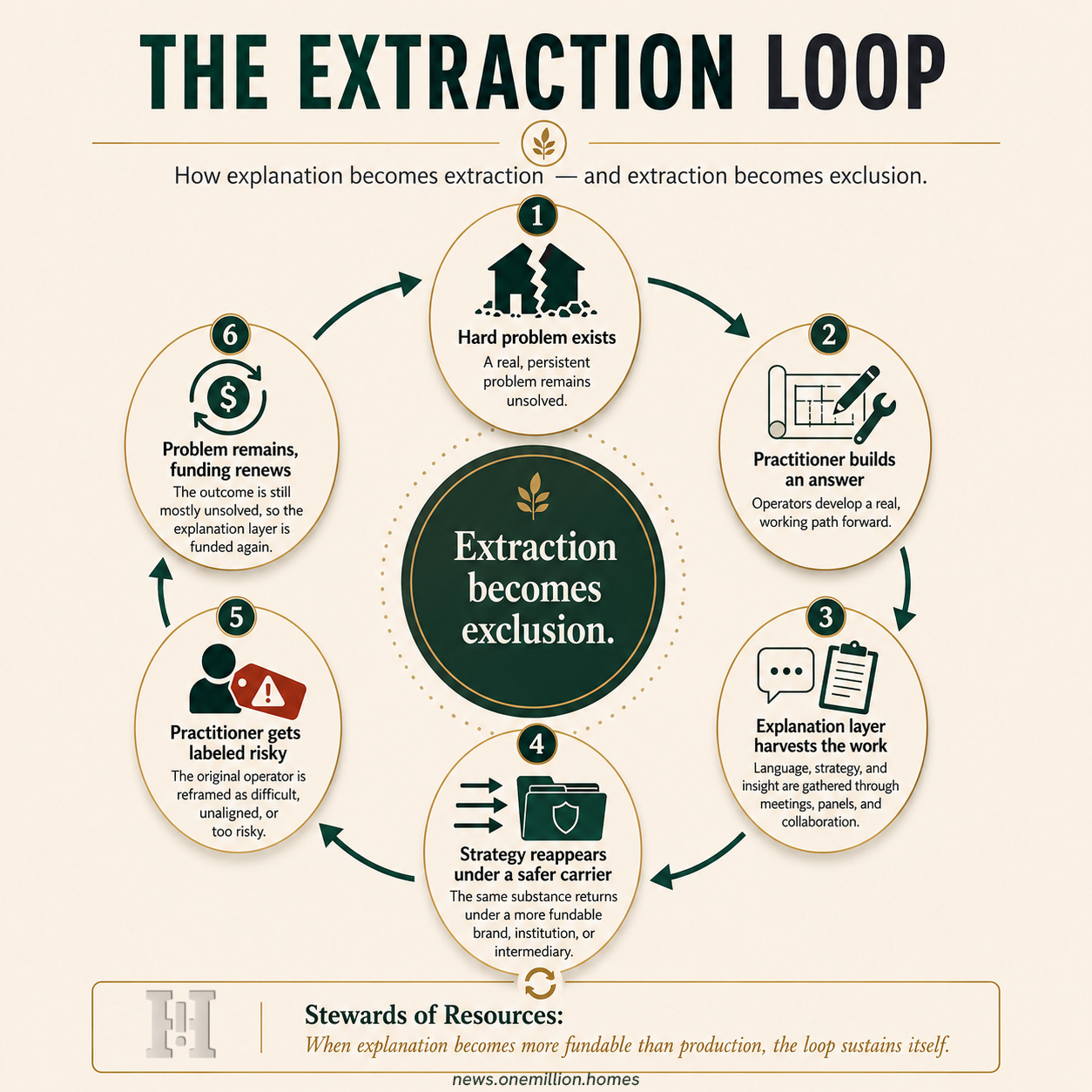
The category survives.
The practitioner does not.
Then comes the reputational move.
The practitioner is not merely excluded. The practitioner has to be explained away.
Because if the practitioner is competent, then the room has to ask why the person closest to the work is no longer in it.
So the labels arrive.
Difficult.
Not collaborative.
Not aligned.
Not scalable.
Scope-creeping.
Too emotional.
Too risky.
The labels do not have to be true.
They only have to create enough hesitation for capital to flow somewhere else.
That is how extraction becomes exclusion.
And once the practitioner is excluded, the problem remains mostly unsolved. Which means the Explanation Industry gets funded again next cycle to explain why the problem remains hard.
That is the Extraction Loop.
It is not a conspiracy. Nobody has to twist a mustache. It runs because every actor inside the loop is doing what is rational from their seat.
That is what makes it durable.
That is also why naming it matters.
5) What this looks like in housing
In Kansas City, urban-core homeownership production over the past 6 years is has dropped 73% from 191 Homes to 51 homes against an identified need of 16,500.

Over that same period, the region has produced studies, panels, plans, convenings, dashboards, advisory groups, and enough language about the housing crisis to make the problem sound thoroughly understood.
That does not mean studying is bad.
Understanding matters.
But at some point, output has to become the test.
If a region can produce thousands of pages explaining the shortage but only dozens of ownership units against a five-figure need, then the explanation layer is no longer merely adjacent to the problem.
It is part of the problem.
And the practitioners know it.
After that regional housing meeting, another local developer gave me the answer more plainly than any report ever will.
When asked why there were not more Black and brown developers at the table, he said:
“F** them. They are wolves in sheep’s clothing.”*
That was not a policy analysis.
It was field intelligence.
He was talking about organizations the funding circuit often recognizes as collaborators, conveners, trust-builders, and community partners.
Collaboration in the public messaging.
Extraction in the business model.
6) One receipt from my own work
I am not writing this because I heard about the pattern.
I am writing this because I have lived inside it.
Two weeks ago, I opened the updated webpage of a newish Kansas City housing nonprofit. Five minutes in, I called my wife:
“It happened again.”
My request for funding, substack posts, and meeting conversations seemed to have been ran through AI to update their model. I pulled the Wayback Machine. I pulled email threads. I pulled meeting dates. I pulled attachments. I pulled published Field Briefs. I ran the comparison through AI.
Fourteen points of overlap appeared that did not exist before their website update.
The clearest was a quote from their CEO calling for a “Housing Engine” — the exact phrase I used in a November introduction meeting with the newly appointed CEO.
When a trusted contact asked leadership to respond, the reply was that the new framing was
“an evolution of their business model and how they communicate.”
A natural evolution — of someone else’s documents.
This is the part where the noise tries to make the story personal.
It is not personal.
If this were only about credit, I would not be writing it.
Credit is not the asset.
The asset is defining the pattern so we can overpower the extractive behavior.
Every dollar that flows toward a paraphrased version of an urban-core housing plan is a dollar that does not flow toward the practitioner who built the plan, holds the relationships, carries the operating risk, and lives inside the boundary the plan is meant to dissolve.
The cost is not bruised pride.
The cost is fewer homes.
7) The organizations may come and go
The Explanation Industry often comes and goes.
Programs sunset. Initiatives rotate. Consultants move on. Strategic plans expire. New names appear for old work.
They leave a wake of damage that only validates to those resources that this is difficult. But maybe it was just difficult because they didn’t actually have skin-in-the-game.
The people called to the work do not move that way.
They are still in the neighborhood after the pilot ends. Still holding relationships after the grant report is filed. Still carrying consequences after the funder moves to the next initiative.
That is one of the easiest ways to tell the bridge from the wolf.
A bridge makes the practitioner more durable.
A wolf makes itself more fundable.
A bridge can leave and the work is stronger.
A wolf leaves and the room has to be convened again.
8) Seven questions stewards should ask
If you steward resources — foundation capital, donor-advised funds, civic capital, family capital, faith capital, bank capital, public dollars — the work in front of you is not only generosity.
It is discernment.
You do not need to become suspicious of everyone.
You do need better questions.
Not accusatory questions.
Due diligence questions.
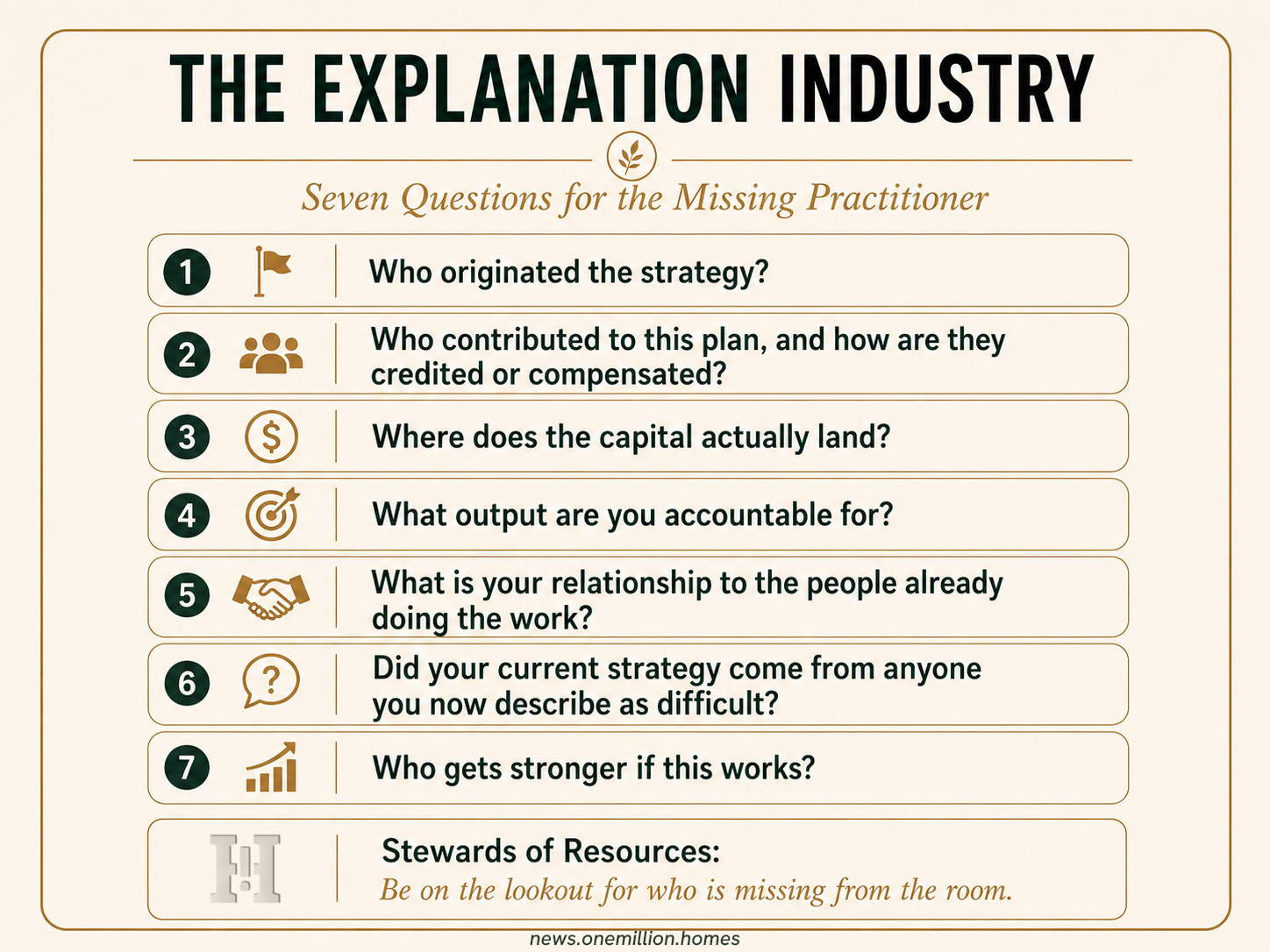
Here are seven I would ask before funding any organization claiming to solve a hard, long-studied problem.
1. Who originated the strategy?
Not who is presenting it.
Who originated it?
Ask directly:
Did this strategy, vocabulary, data architecture, or operating model originate inside your organization?
If the answer is no, ask:
Who did it originate with, and are they still in the room?
A clean partner can answer this cleanly.
A wolf gets vague.
2. Who contributed to this plan, and how are they credited or compensated?
Ask:
Which practitioners, developers, operators, residents, or smaller organizations contributed to this model?
Then ask:
How are they credited, compensated, protected, or included in governance?
A bridge can show the chain of contribution.
A wolf hides the chain.
3. Where does the capital actually land?
This is the question that reveals the model.
Ask:
If we fund you, does capital move closer to the practitioner doing the work, or does it stop with you?
Then ask:
What percentage of this funding reaches the operator, builder, provider, or practitioner closest to the outcome?
A bridge passes capital through with clarity.
A wolf absorbs capital and calls it coordination.
4. What output are you accountable for?
Not what activity.
What output.
Ask:
What will exist in the world because of this funding that does not exist today?
Homes built. Families housed. Units delivered. Providers expanded. People employed. Recidivism reduced. Grocery access created. Childcare seats opened.
If the answer is another report, plan, convening, dashboard, or framework, that may have value.
But call it what it is.
Explanation.
Not production.
5. What is your relationship to the people already doing the work?
Ask:
Who is already producing this outcome at a smaller scale?
Then ask:
Have they asked you to play this role?
That second question matters.
A bridge is usually invited by practitioners because it helps them cross a gap.
A wolf appoints itself as the voice of practitioners who are not present.
And if the practitioner publicly disagrees, corrects the model, or challenges the strategy, ask what happens next.
A bridge can tolerate correction from the field.
A wolf requires gratitude as the price of access.
6. Did your current strategy come from anyone you now describe as difficult?
This one will make people uncomfortable.
Good.
Ask:
Are there practitioners you consider difficult, not collaborative, or not aligned?
Then ask:
Did any part of your current strategy come from conversations, decks, meetings, or materials involving those practitioners?
If the answer is yes, slow down.
You may be looking at the Extraction Loop in real time.
7. Who gets stronger if this works?
Finally, ask:
If this grant succeeds, who has more power at the end — your organization, or the practitioners closest to the work?
That question will tell you almost everything.
A bridge leaves the practitioner stronger.
A wolf leaves the practitioner dependent, invisible, or removed.
A bridge can become less central over time because the work has more capacity.
A wolf becomes more central because the work cannot move without it.
That is the difference.
9) John 10
After the most recent instance, I went back to John 10.
The hired hand runs because the sheep do not belong to him.
The thief comes to steal, kill, and destroy.
But the passage does not end with the thief.
It ends with life.
That matters.
The point of naming wolves is not paranoia.
It is protection.
The point is to help stewards recognize who protects the work, who extracts from it, and who makes the people closest to the work stronger.
The shepherds are real.
They are operating.
They are findable.
They may not be on the foundation circuit. They may not pitch with practiced confidence. They may not have a communications director. They may not know how to ask in the polished language of the people who have learned to be funded.
That is not weakness.
That may be the proof.
10) The call
To the practitioners:
Keep going.
The work is the asset. The math is the asset. The integrity of the path is the asset.
The people who can rewrite your story in someone else’s deck cannot do the work in your place.
They are reading the recipe out loud while you are still in the kitchen.
To the stewards with resources:
Ask better questions.
Do not fund only the people who explain the problem well.
Find the people who are already solving it badly, imperfectly, locally, stubbornly, without enough capital, without enough staff, without enough institutional cover — and ask what would happen if they were protected instead of mined.
Ask who originated the strategy.
Ask where the capital lands.
Ask what output will exist.
Ask whether the practitioner remains in the room.
Ask who gets stronger if this works.
Ask outside the room you usually fund inside.
The names come up fast once you do.
Key terms: The Explanation Industry · Collaborative Extraction · The Extraction Loop · Non-Extractive Bridge