



[7 Minute Read - 90 Seconds For Skimmers]
Short Version:
What: One investment commissions a KC housing‑production engine designed to run ~500 homes/year at steady state—capacity, not one‑offs. Targets: 12–14% IRR; 4‑year hold; ~$30M gross profit.
Why now: $13.9M committed to date, including a $5M lender‑controlled construction line, ~$1.4M state tax credits, and a $7.5M SBA commitment to expand advanced manufacturing for scale. First home underway; 10 adjacent lots queued.
Two on‑ramps: LPs → Fund II (commission the full cell with milestone capital calls). DAFs/Foundations → Call 0 (a $250k restricted grant to finish pre‑development and permit the first 10; bank line funds vertical).
The housing crisis isn’t unsolvable—
It’s uncoordinated. Fund II changes that.
Everyone agrees there’s a housing crisis.
But what if all the noise around it—the reports, panels, and endless debate—is really a distraction keeping it unsolved?
Because when you cut through the noise, the math isn’t mysterious.
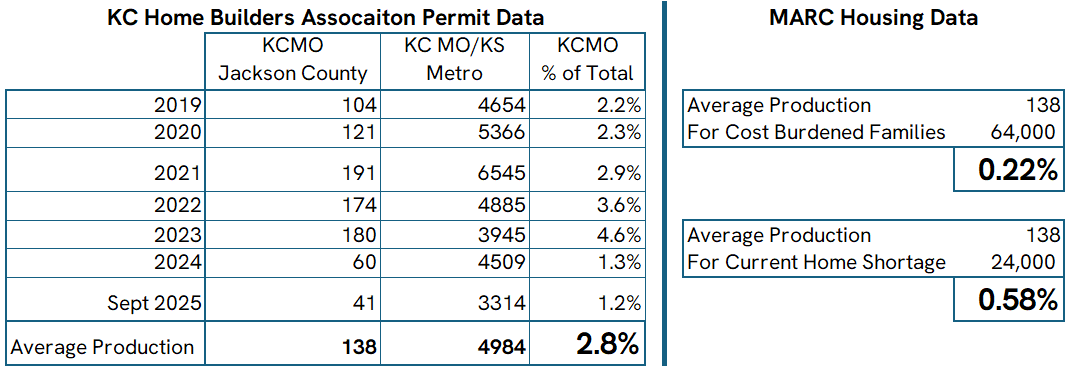
Kansas City needs 24,000 homes. Last year, only 60 total single family homes were built in the urban core, we’re on pace this year for 54. We haven’t produced more than 191 since 2019. The fix isn’t abstract—it’s production.
If we can lift production from 60 homes a year to even 2,400 homes a year, we close the gap in a single decade.
The challenge isn’t who will buy them, or who will build them, or even how to fund them.
The unspoken challenge is WHERE this production needs to happen— inside the city’s so-called “high-risk” urban core neighborhoods.
As operators, and not intermediaries, we’ve tried every strategy that exist and still arrive to the same conclusion. The root problem isn’t affordability, labor, capital or demand… the root problem is:
NO SYSTEM exists in the urban core to coordinate buyers, labor, and capital into housing production at scale.
That’s what Fund II solves for:
A new kind of housing infrastructure that makes production repeatable—a steady cadence of homes neighborhood by neighborhood —and finally brings throughput back to Kansas City’s core.
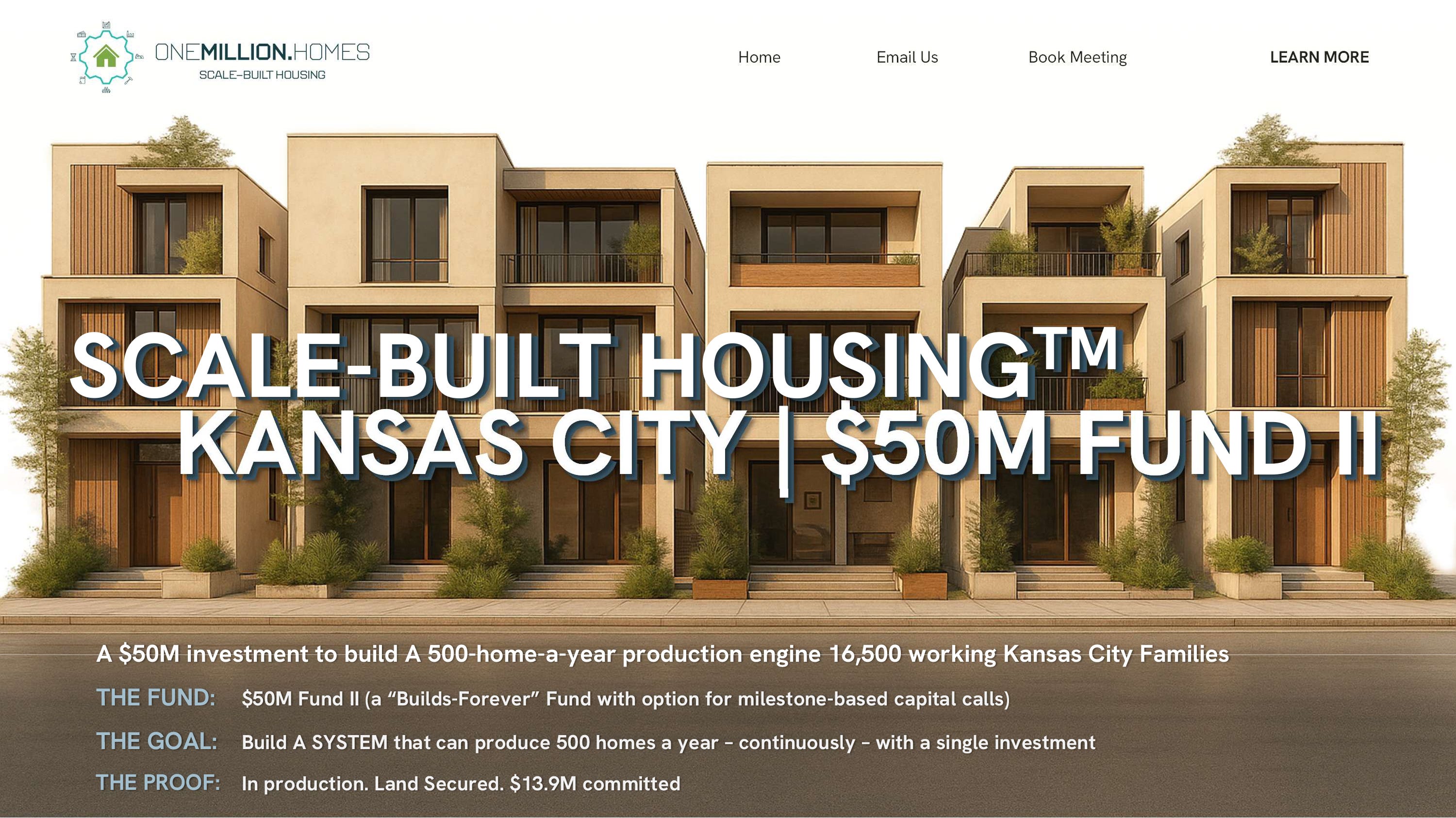
The $50M Engine That Builds 500 Homes/Year →
Series Navigation:
Use this series to navigate the opportunity: Start Here (0/3) for the overview, Companion — Call 0 for the $250k DAF grant sprint, then 1/3 Why $50M, 2/3 Milestone Capital, and 3/3 Competency to see how the engine scales to ~500 homes/year.
0/3 Start here · (this post)
Companion: Call Zero ($250k grant) ·
1/3 Why $50M ·
2/3 Milestone Capital ·
3/3 Competency
CLICK HERE to Book A Call and Request Our Materials.
Or Read On Below:
Thanks for reading OneMillion.Homes! Subscribe for free to receive new posts and support our work.
This post is public so feel free to share it.
Hyperlinked Table Of Contents:
Core Problem = Urban Donut
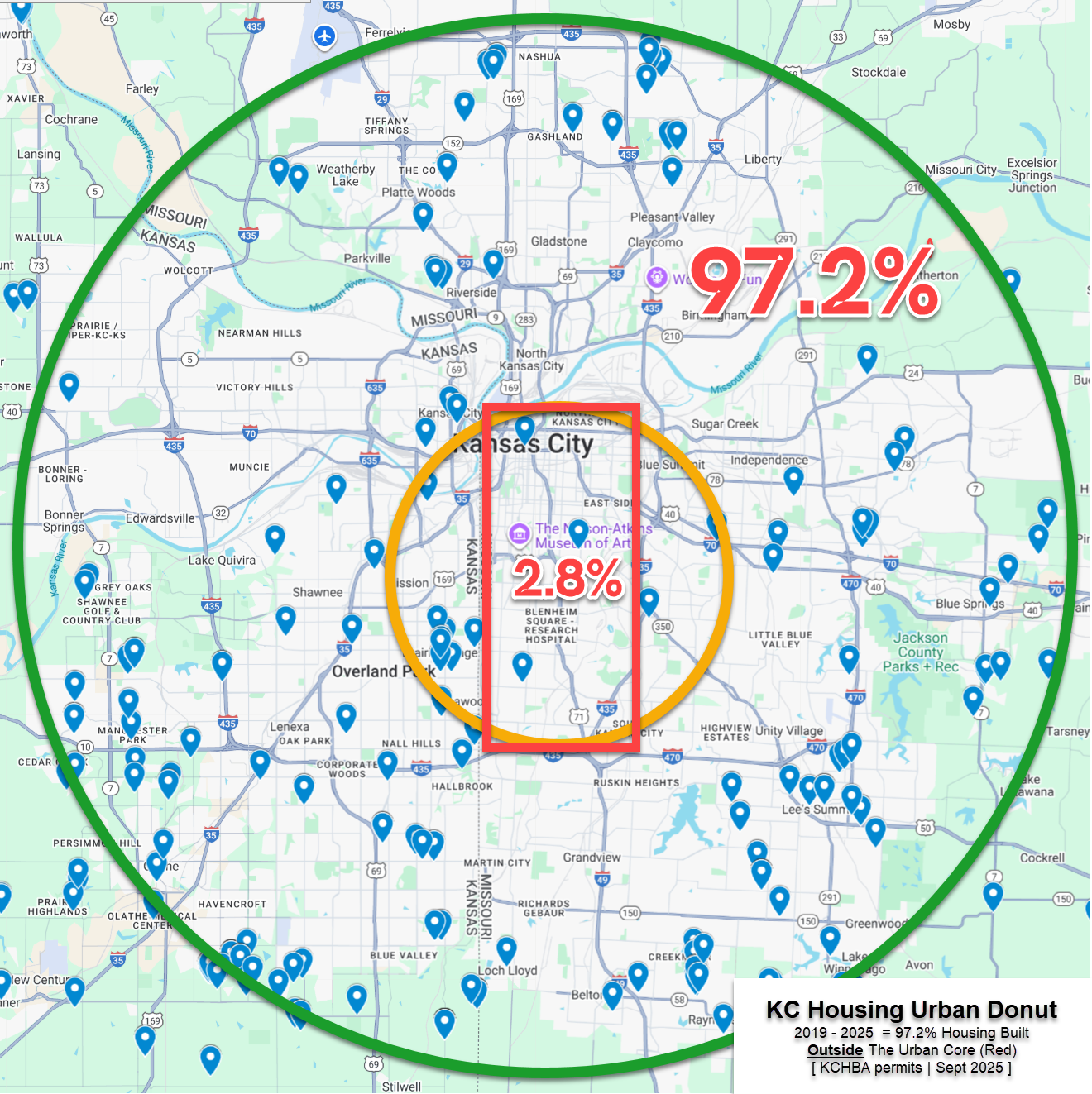
Demand Trapped, Production Paralyzed
Kansas City isn’t short on buyers; it’s short on capacity where buyers live.
The urban core is the “donut hole”—builders avoid it. The problem isn’t that Kansas City can’t build homes — it’s that our production system is not existent in the core. Every player—builders, lenders, suppliers, agencies, and buyers—operates in fragments, with no shared platform to align timelines, budgets, and outcomes.
Since 2019, the city has averaged 138 single‑family permits/year, just 2.8% of regional output. That means 97.2% of new homes are built outside the core.
At the same time,
64,000 KCMO families (and 186,000 across the metro) need affordable homes.
MARC Estimates project a 24,000‑home shortage.
And based on income → 16,500 “missing‑middle” families could afford to buy a home if the product existed on the market.
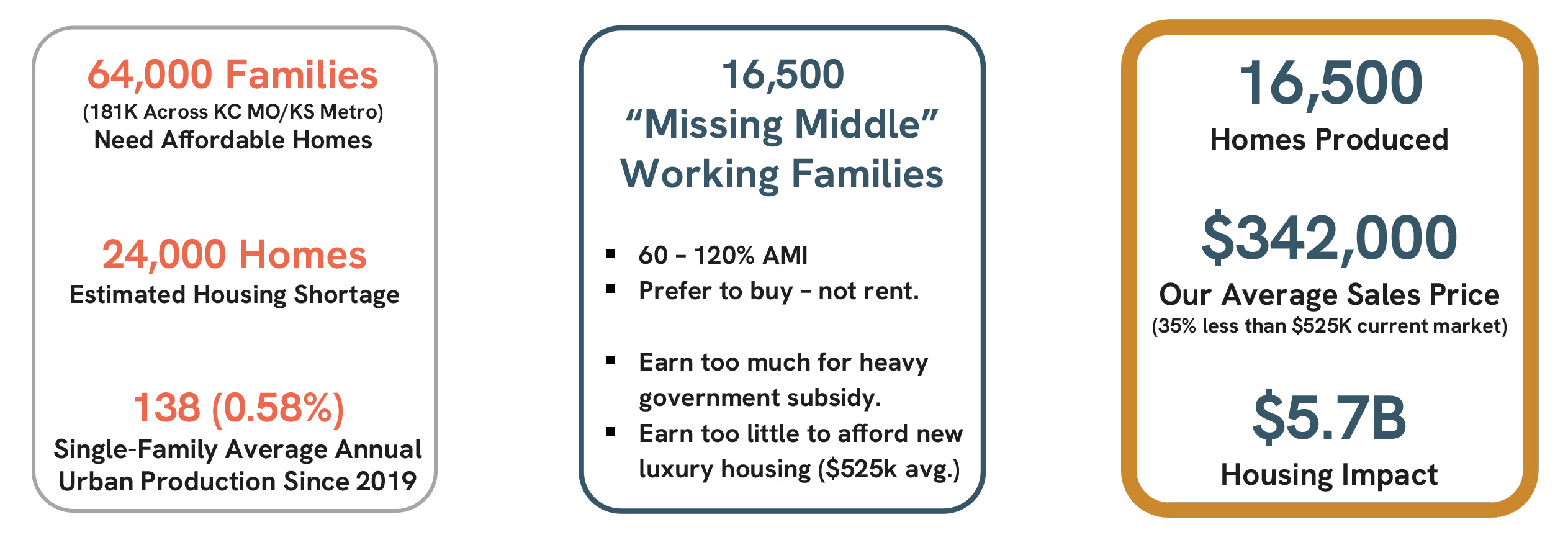
That’s $5.7 Billion Economic Opportunity for Investors and Kansas City’s Urban core.
Investor translation: this is not a “find more buyers” problem; it’s a capacity and orchestration problem. The winning asset isn’t a project—it’s an engine that converts trapped demand into predictable, repeated closings in the core.
Our Answer: Build A New Housing Infrastructure
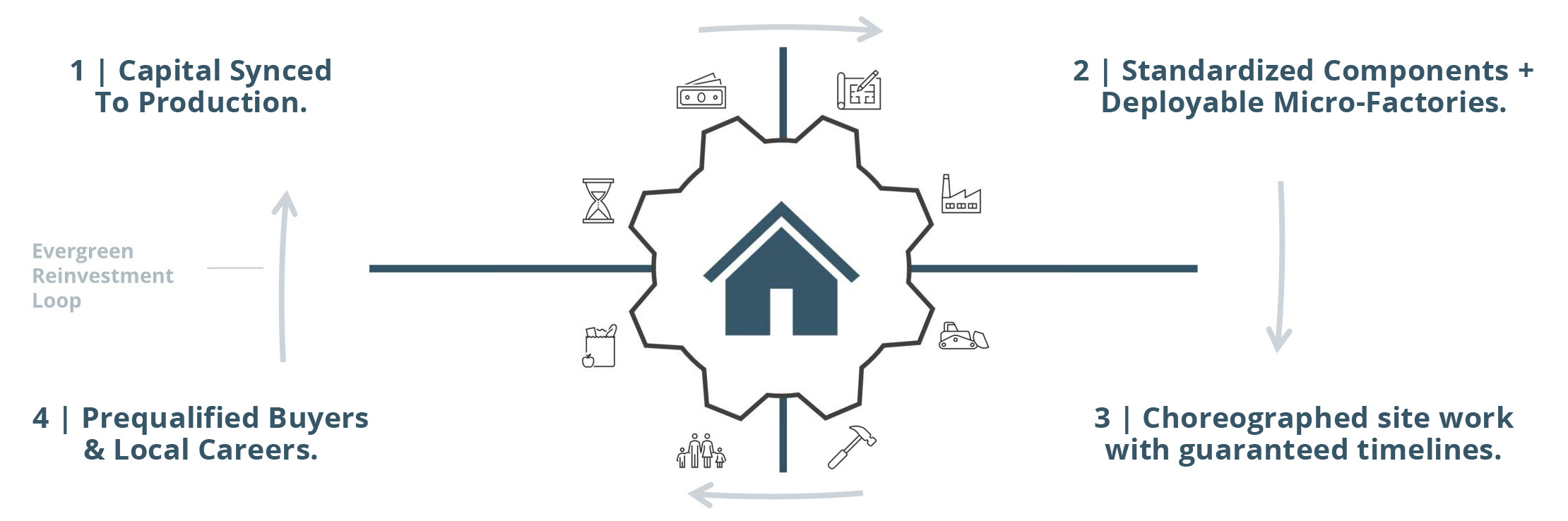
Fund II commissions a new housing infrastructure that can coordinate these moving parts like a factory floor. We collapse fragmentation into one platform: capital synced to production + standardized design kits + choreographed fieldwork + and pre-qualified buyers ready to move in.
This isn’t another one-off development—it’s an engine that converts what’s already in Kansas City (labor, demand, and capital) into coordinated throughput. It functions like an operating system for housing, turning fragmented efforts into a repeatable cadence of production.
When fully commissioned, each engine can deliver a steady ~500 homes per year—transforming the urban core from a “high-risk” environment into the most investable, scalable geography in the city.
Why $50M (and Not Less)
Scale is a requirement. Anything smaller can’t purchase the competency + standardization that remove bottlenecks and hold schedule/cost.
To execute at scale, the full $50 million must be committed upfront, even though capital will be drawn by milestone. That commitment allows us to confirm—before breaking ground—that every trade partner, utility, supplier, and broker can dedicate capacity for a 500‑home run, not bid piecemeal house‑by‑house. Nothing slows production more than having only enough capital to reach the next step but not enough to reach completion; it’s the critical barrier in urban‑core housing. With full commitment, we can negotiate block pricing, lock supplier allocations, and schedule crews and utility work in sequence—reducing risk, eliminating the fragmentation tax, and securing predictable cost and delivery for everyone involved.
Capital Calls: Milestone‑Based, Throughput‑First
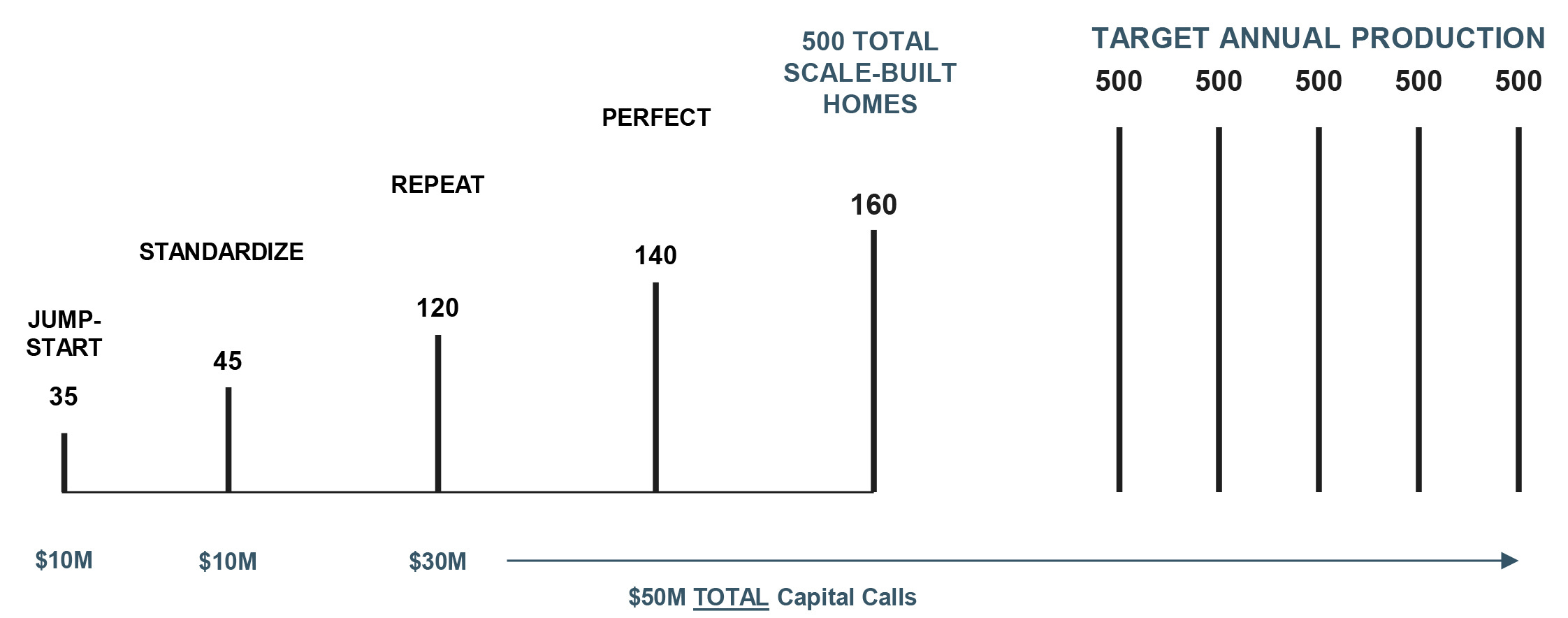
Phasing (capital calls):
$10M Jump‑Start (~35) →
$10M Standardize (~45) →
$30M Repeat (~120 → 140 → 160) =
~500 total, then steady‑state ~500/year per cell. Targets: 12–14% IRR; 4‑year hold; ~$30M GP.
We call capital when the engine proves it, not by date.
Scoreboard you’ll see every month: permits filed → permits issued → first foundation pour (construction draws then flow from the bank line).
This keeps risk where it belongs: on execution, measured by throughput.
Why Batches of Homes (Not One‑Offs)
One mobilization, many results: surveys, utilities, inspections, dumpsters, fencing—shared once across the block.
Bulk Purchasing Discounts: material / labor quantifies hit costs breaks 30 - 50% less.
Material Quality Increases: high-quality can be purchased at scale and the benefits are passed onto the families.
Flow the work: pour foundations → frame walls → MEP rough‑in → inspections → close‑in; inspectors bundle us; cycle time improves.
Keep top trades on site: ten side‑by‑side gives the best pros enough runway to stay.
Buy like a producer: truckloads, not single units—windows, HVAC, fixtures, even toilets for the whole block—so material/logistics savings can be reinvested in quality and passed on to buyers.
Block effects: adjacent homes create safety, comparable, and visible momentum—not scattered one‑offs.
Competency of Operators
(not third-party intermediaries)
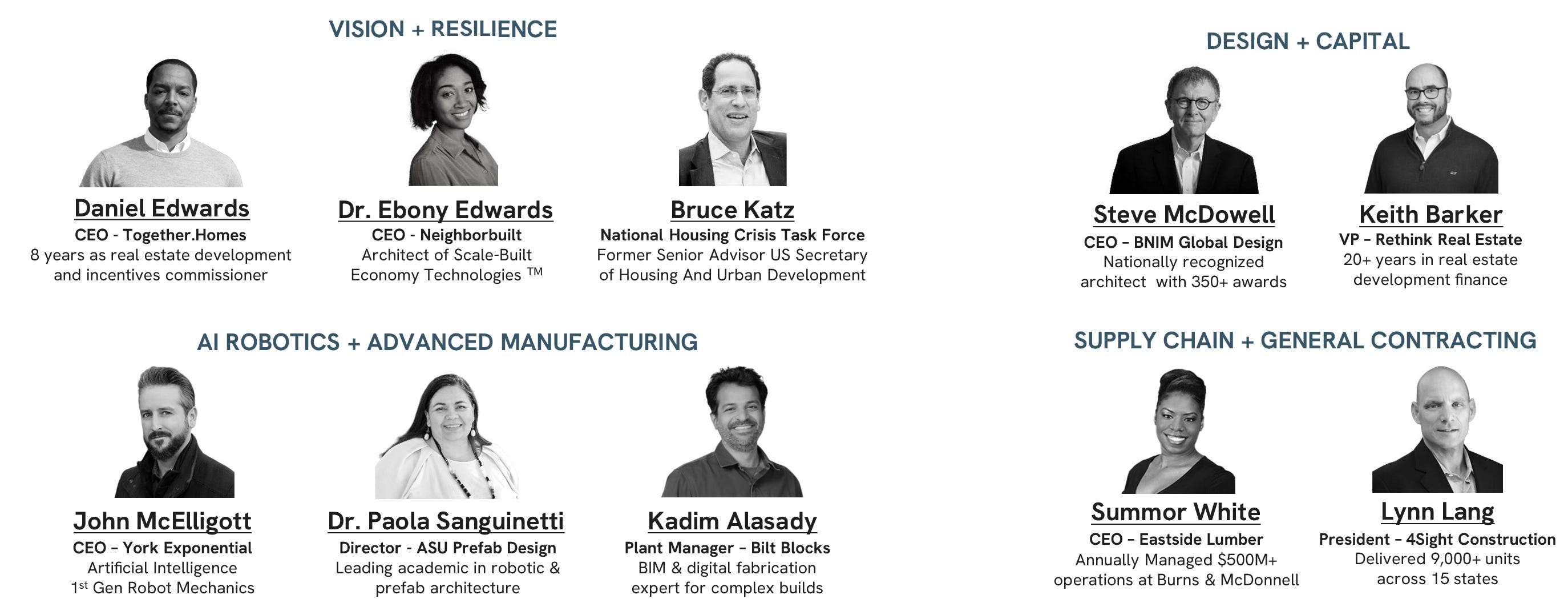
Together.Homes is production cooperative of established experts.
Each partner specializes in a critical lane, aligned to a single goal: stand up a repeatable housing engine that delivers ~500 homes/year. We know the urban-core realities first-hand and we’ve each brought a piece of the solution; together, the pieces run as one system.
Capital doesn’t just pay for sticks and bricks—it invests in right team solving the right problem: the people, playbooks, QA, scheduling, and supply control that make outcomes predictable and repeatable.
MovementKC (501(c)(3)) — leads pre-development & buyer recruitment (DAF/Call-0 scope).
BNIM — national design leader (Steve McDowell, Board VP).
4Sight Construction — GC with 9,000+ units delivered.
Eastside Lumber — local supply control and logistics.
Rethink Real Estate - development finance coordination.
Together.Homes + Neighborbuilt — coordination system of everything above.
What’s Already De‑Risked in KC
Status: One home is underway; ten are queued; the cell is designed to hold ~500 homes/year at steady state.
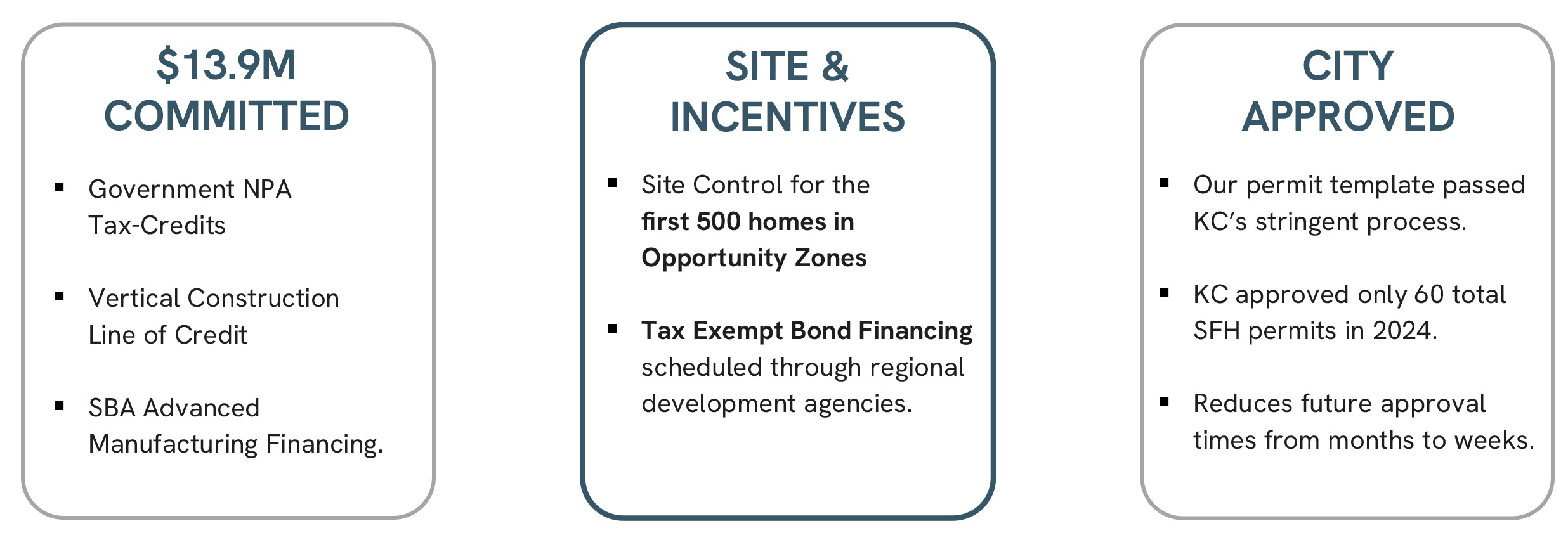
$13.9M committed to date, including:
$5M lender‑controlled construction line (underwriting complete; lender manages draws).
~$1.4M state tax credits contracted for purchase at completion.
$7.5M SBA letter of commitment to build out advanced manufacturing capacity that supports scale production.
Permit template approved (months → weeks).
Addresses: 2509 Michigan underway; 2501–2521 queued to file.
Flexible investment strategies (choose your lane)
We can tailor the capital stack by policy and mandate while keeping the same capacity outcome:
Fund II (Equity) — “Build → Sell → Repeat” cycles within the cell; return capital as cohorts exit.
Private Debt — senior/pari passu structures against defined milestones and take‑outs.
Qualified Opportunity Zone Equity — where eligible, for investors seeking OZ benefits (subject to counsel).
DAFs/Foundations — Call 0 ($250k restricted grant) to permit the first 10; alternatives include recoverable grants/PRIs (0–2%) or forgivable components for deep impact.
Note: Final structures, terms, and tax treatment subject to offering documents and investor counsel.
Terms At A Glance
Fund: Scale‑Built Housing KC Fund II — $50M.
Use: Commission one KC production cell; deliver its first ~500 homes of throughput.
Targets: 12–14% IRR; 4‑year hold; ~$30M gross profit.
Tax: OZ/tax‑advantaged strategies where applicable.
Two Clear CTAs
(Same Destination: Capacity)
Investors (LPs): Request the Fund II deck (phasing + terms) and book a 30‑minute diligence call.
DAFs/Foundations: Request the 7‑slide Call 0 Grant Deck (budget + map, de‑risking, milestones) and book a 20–30 minute briefing with Dan / Dr. Ebony / Steve (BNIM).
Email: Daniel@1M.Homes
Disclosure: Informational only; any offering is made solely by formal documents. Call Zero is a request for charitable grant support to MovementKC 501(c)(3) for pre‑development only; no grant funds touch vertical; the lender controls all construction draws.